


Last Updated: 27 April 2026 | 1 min read
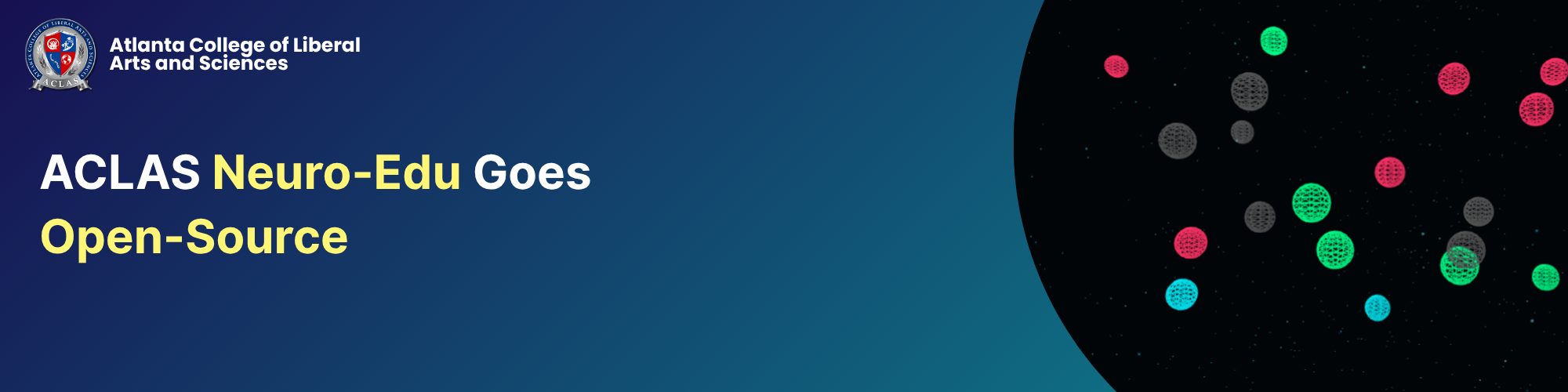
The Atlanta College of Liberal Arts and Sciences (ACLAS) just dropped a massive contribution to the AI community. Neuro-Edu, their proprietary autonomous cognitive simulation framework, is now officially open-source. This isn't your typical "GPT-wrapper" project. Neuro-Edu represents a shift toward first-principles AI development, moving away from API dependencies and toward deep-tier cognitive modeling.
The Tech: First-Principles Cognition
While much of the EdTech world is focused on prompt engineering, ACLAS has been building a localized, autonomous stack. The framework is designed to model actual human knowledge acquisition through three core technical pillars: 1. On-Device Neural Networks: Optimized for local execution, ensuring privacy and reducing latency for real-time pedagogical simulations. 2. Vector-Space Semantics: Moving beyond simple keyword matching to map how concepts relate to one another in a multi-dimensional knowledge map. 3. Cognitive Entropy Analysis: Using thermodynamic entropy principles to measure how effectively information is being "ordered" and retained by a learning agent.
Why It Matters: The "Anti-Fragile" University
The mission behind the code is as ambitious as the math. ACLAS describes this as a step toward building an Anti-Fragile University, an educational infrastructure that doesn't just survive disruption but improves because of it. By open-sourcing the SDK, they are democratizing the tools needed to build high-level, personalized learning environments that can scale globally without massive per-token costs.
Dive into the Neural Dashboard
One of the most striking components of this release is the Live 3D Neural Dashboard. It allows researchers and developers to visualize multi-agent learning environments in real-time, watching how agents navigate complex curricula and interact within a digital classroom.
"We firmly believe that every mind deserves access to world-class education. To make this a reality, we’ve built an advanced AI system that actually simulates how humans learn," said ACLAS Team.
Get Involved
The code, models, and documentation are live and ready for deployment. Whether you are a researcher looking into cognitive entropy or a developer building the next generation of LMS, the Neuro-Edu stack is now yours to build upon. GitHub/Hugging Face: Search for ACLAS Neuro-Edu
Live Demo & Docs: aclascollege.github.io/neuro-edu/
Recent Post
Popular Programs
Master of Business Administration
The MBA program is designed to provide students with the essential skills and credentials necessary for career advancement in business management and leadership. It is a quick and cost-effective way to boost your resume and reach your career goal.
Doctor of Business Administration
The Doctor of Business Administration (DBA) program is meticulously designed for professionals aspiring to be leaders in their own right within the business they are involved in. Unlike the PhD programme, the Online DBA is carefully designed to fill the scholar’s journey with key elements that can make an impact on their careers and on the stakeholders they deal with.The program offers an advanced curriculum blending theoretical insights with practical applications, equipping graduates for strategic decision-making and research-oriented roles.
Master of Computer Science
The Master of Computer Science (MCS) program at Atlanta College of Liberal Arts and Sciences (ACLAS) offers a robust, affordable, and flexible education tailored to meet the demands of today’s tech industry. With a unique blend of theoretical and practical learning, the program equips students with the skills and knowledge needed to excel in computer science, while offering a specialized focus on healthcare applications and industry-relevant technologies.
Bachelor of Business Administration
The Bachelor of Business Administration (BBA) at ACLAS College is a comprehensive online undergraduate program that builds foundational knowledge across management, marketing, finance, and strategy. Study at your own pace and earn a U.S. bachelor's degree from anywhere.
Bachelor of Science in Computer Science
This Bachelor of Science in Computer Science Online Video Degree Program features 12 core professional courses structured into a clear, four-stage learning path—spanning programming fundamentals, system architecture, network engineering, and advanced AI & distributed systems. Blending academic rigor with modern industry practices, the program helps learners build a solid, full-stack computer science foundation and system-level computational thinking without the pitfalls of fragmented learning.
Mini-MBA Certificate
A 100% online Mini-MBA program covering the essential pillars of modern business: management, strategy, finance, analytics, operations, and organizational leadership.
Executive Certificate in Project Management
Build practical project management capability for planning, leading, adapting, and delivering projects with greater confidence and organizational impact.
Executive Certificate in Innovation Management
Develop the mindset and tools to lead innovation, manage change, and guide digital transformation. This 100% online certificate program combines design thinking, innovation management, change leadership, and digital business transformation.
Executive Certificate in Financial Management
Build essential financial fluency for business decision-making. This 100% online certificate program covers financial concepts, accounting principles, performance analysis, and investment fundamentals.
Executive Certificate in Strategic Management
Develop strategic thinking for organizational growth, competitive positioning, operational alignment, and leadership decision-making.
Executive Certificate in Global Governance
Understand the political, legal, economic, and sustainability forces shaping global institutions, international cooperation, and cross-border decision-making.
Executive Certificate in Sustainable Business
Explore how sustainable business, ethical decision-making, innovation, and long-term development shape responsible organizations and future-ready leadership.
Professional Certificate in Business Analytics
Build practical analytics capability for business decision-making. This 100% online certificate program covers business analytics, data science, databases, and applied machine learning.
Professional Certificate in Artificial Intelligence
Build a practical foundation in artificial intelligence, machine learning, data science, and large language models for modern business and technology environments.
Executive Certificate in Digital Transformation
Develop the business, innovation, analytics, and digital economy foundations needed to understand and lead digital transformation initiatives.
Professional Certificate in Marketing Strategy
Build a practical foundation in marketing strategy, customer understanding, brand communication, and market-focused business growth.
Executive Certificate in International Business
Build a practical foundation in international business, global markets, cross-border communication, and the legal and economic forces shaping global commerce.
Executive Certificate in Operations Management
Build practical operations capability for improving processes, aligning execution with strategy, managing projects, and using analytics to support better operational decisions.
Professional Certificate in Human Resource Management
Build a practical foundation in human resource management, organizational behavior, team development, and workplace communication.
Executive Certificate in Risk Management
Build practical capability to identify risk, manage uncertainty, respond to crisis, and support ethical and resilient organizational decision-making.
Executive Certificate in Business Law
Build a practical foundation in business law, ethics, international legal principles, and risk management for responsible organizational decision-making.
Executive Certificate in Entrepreneurship
Build a practical foundation for launching, managing, and growing ventures through strategy, innovation, finance, and marketing.
Professional Certificate in Economics
Build a practical foundation in economic reasoning, markets, policy, macroeconomic forces, microeconomic behavior, and the digital economy.
Professional Certificate in Cybersecurity
Build a practical foundation in cybersecurity, cloud computing, database systems, and software engineering for modern digital environments.
Professional Certificate in Cloud Computing
Build a practical foundation in cloud computing, software engineering, database systems, and computer security for modern digital infrastructure.
Professional Certificate in Blockchain Business
Build a practical foundation in blockchain, digital transformation, internet business, and investment concepts for emerging digital markets.
Executive Certificate in Corporate Governance
Build a practical foundation in corporate governance, business ethics, legal awareness, risk management, and organizational behavior.
Professional Certificate in Data Science
Build a practical foundation in data science, databases, machine learning, and programming concepts for modern analytical and technology-driven work.
0 comments